

🥽Could the Vision Pro be Apple's first commercial failure?
Apple makes Meta look crappy, but also attracts negative reviews on its headset

The best design is the one you don't notice because it's doing its job.
— Nils-Petter Norlin
🍎A classic Apple launch strategy, but not so much
Last week, Apple launched the Vision Pro, its first headset and largest new product release since the Apple Watch in 2015. The Vision Pro is focused on entertainment and in a new way of computing (coined spatial computing) and is expected to start selling next year, priced at $3,500 😲.
We all know that this is not a new product - for a long time, Meta has been doubling down its bets on the Metaverse thesis, and so far has reportedly sold 20M headsets since 2018. Its latest version is called the Quest Pro and is priced at $1,500.
The Vision Pro release seems to be a classic case for Apple’s product launch strategy: rather than being the first to introduce something new, they tend to bring the premium version. Apple has been studying virtual reality (VR) use cases for quite some time: in 2020, it bought Next VR, a company focused on sporting events and concerts.
🥽 High-tech headset comparison: Apple (Spatial Computing) x Meta (Metaverse)
Apple’s Vision Pro is all about entertainment: watching movies, playing games, taking photos (it has Apple’s first-ever 3D camera), reading and basically taking the entire experience from your desktop to a virtual, spaceless world.
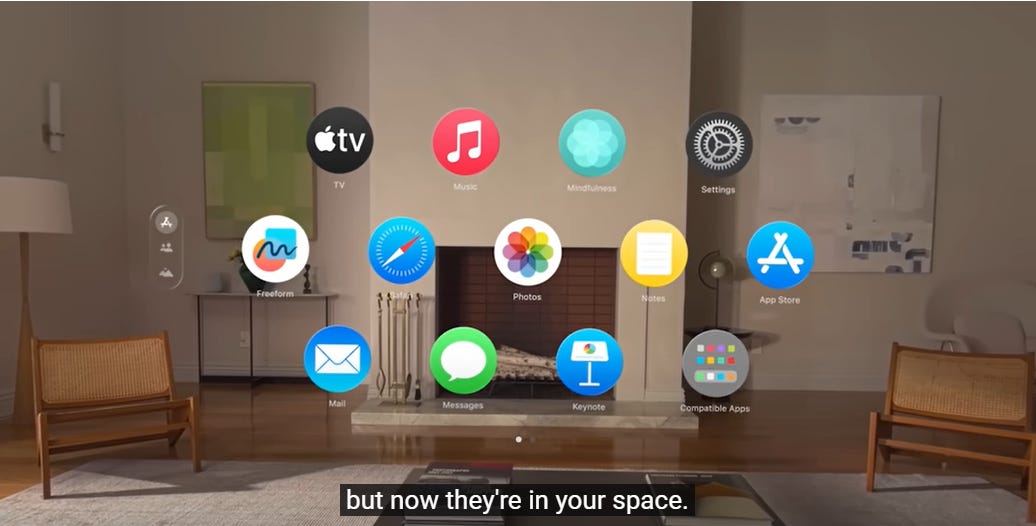
Screenshot from Apple’s Vision Pro launch video. Source: Apple.
The Quest Pro, on the other hand, is all about the controversial Metaverse thesis, now being applied for work and meetings. For this, Meta developed a partnership with Microsoft Teams.
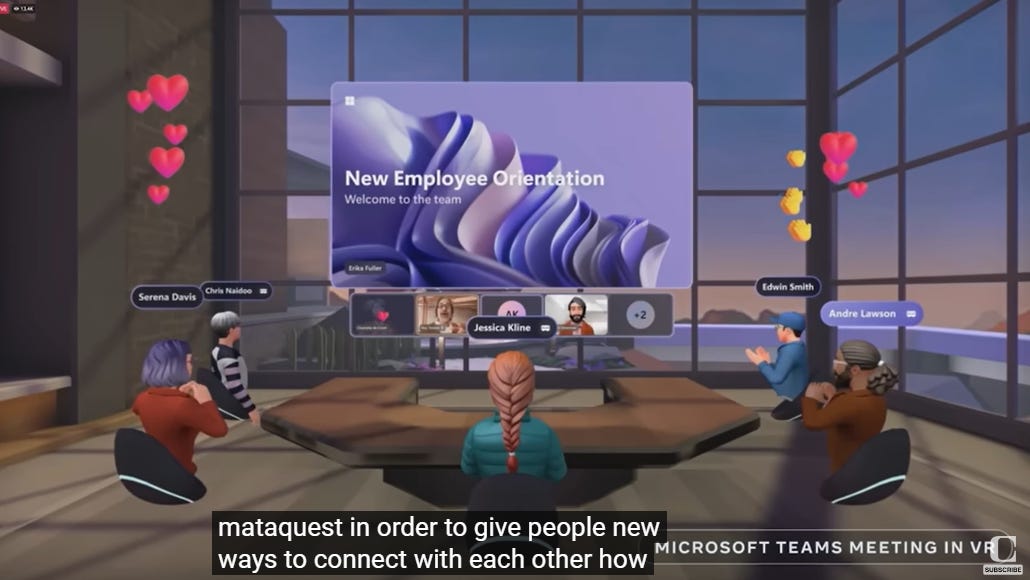
Screenshot from Meta’s Quest Pro launch video. Source: Meta.
💎A technical achievement
One thing is for sure: Apple’s headset technology surpasses that of Meta’s by miles: it has a sleeker design, a more seamless experience, an ultra-high resolution for text and images/videos, creates no motion sickness and has an incredible eye-tracking feature that allows users to select things with their eyes and hand motion. 😲
VR experts from the Cortex podcast called Apple’s Vision Pro is “unbelievable”. However, they also acknowledged that it is still far from perfect: it is heavy, becomes obsolete in 2 years, and is crazy expensive. Meta’s Quest Pro has similar problems, but at least sells for $1,500.
Bryan Chen, the NYT tech expert, said he “walked away with mixed feelings, including a nagging sense of skepticism”. Scott Galloway said that this will be Apple’s first big commercial failure of the century - he even dives into basic human DNA reasons for users not want to adopt it 🙈.
👎🏽Too big to fail?
This would not big a Big Tech’s first commercial failure - remember Google Glass and Amazon’s Fire smartphone? But, for a company such as Apple (that arguably created the most successful consumer product in the world - the iPhone), this is a surprise, and makes me wonder why it launched it.
Both Apple’s Vision Pro and Meta’s Quest Pro seem to come at a bad timing: we are at a moment when human connection is needed more than ever. Quoting Rex Woodbury , we are in the midst of a loneliness pandemic, and companies are requesting employees to come back to work in presence.
According to tech expert David Pogue, the Vision Pro’s crisp resolution “made the displays in the [Meta’s] Oculus look like a screen door”. Is the Vision Pro aimed at showcasing Apple's superiority over its competitor, Meta? (check this article to understand this rivalry).
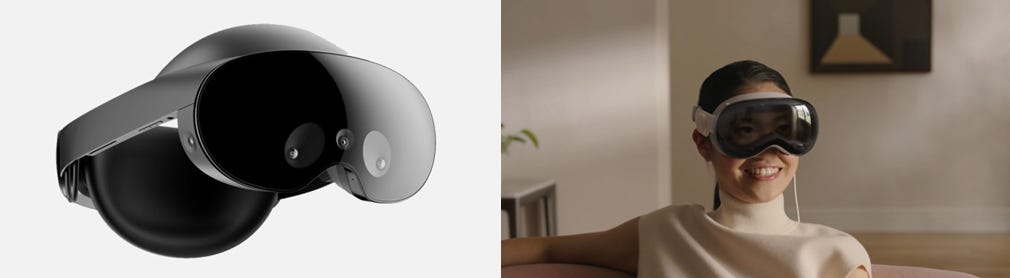
Left: Meta’s Quest Pro. Right: Apple’s Vision Pro. Sources: Meta and Apple.
🎮The future of headsets - gaming
I have a tough time believing that the Vision Pro will be commercially successful, especially when priced at $3,500.
Yet, I do believe that many companies can actually succeed in the VR industry, and this will take place be in gaming. In early 2023, Sony launched its Sony’s PlayStation VR2 (priced at $550), which sold 600k units in its first six weeks.
More to come…